
Arbor Max Tree Service provides commercial forestry mulching throughout Berks County. Property managers, HOA boards, municipalities, schools, general contractors, and utility agencies use our mulching equipment to clear brush, underbrush, and small to midsize trees across large areas quickly and with far less ground disturbance than traditional clearing methods.
Forestry mulching uses a mounted rotary head to grind standing vegetation into mulch right where it stands, instead of cutting it down and hauling it away. For a commercial property with acreage to manage, whether it is a utility corridor, a large parcel ahead of development, or a neglected section of a park or campus, that difference in method often means the job gets done faster, with less soil disturbance, and without the truck traffic and disposal cost that comes with traditional land clearing.
Commercial Forestry Mulching Services in Berks County
Our mulching equipment handles dense brush, vines, saplings, and small diameter trees in a single pass, leaving behind a layer of mulch that suppresses regrowth, controls erosion, and breaks down naturally into the soil. This makes forestry mulching especially well suited to sites where minimizing ground disturbance matters, including stream buffers, wetland areas, and slopes where traditional bulldozing would leave bare soil exposed to erosion. We follow equipment operating practices consistent with published guidance on operating forestry mulchers safely, which covers machine setup, terrain assessment, and safe clearance around obstacles, so a large mulching job gets done efficiently without unnecessary risk to the crew or the property.
Mulching is also significantly faster than traditional clearing for the right kind of site. A utility company clearing a right of way, a municipality opening up a trail corridor, or a developer clearing understory ahead of a site plan can often cover several acres in the time it would take a traditional crew to cut, drag, and haul the same area. For a property that pays for downtime or has a construction schedule riding on clearing being finished, that speed translates directly into lower cost.
When Forestry Mulching Is the Right Tool
Mulching works best on brush, vines, and trees generally under eight to ten inches in diameter. For a site with larger mature trees that need to come down, we pair mulching with our tree removal crew, clearing the understory with the mulcher and removing larger trees separately, so the whole site gets cleared in one coordinated project instead of two disconnected ones.
Mulching also leaves a property in better shape immediately after the work is done than traditional clearing does. Instead of exposed dirt and stacked piles of cut brush waiting on disposal, the site is left with a finished mulch layer that a property can walk, mow around, or build on right away. For a property manager working against a lease turnover date or a contractor working against a permit deadline, that finished condition on day one, rather than after a separate cleanup phase, is often the deciding factor in choosing mulching over a traditional clearing crew.

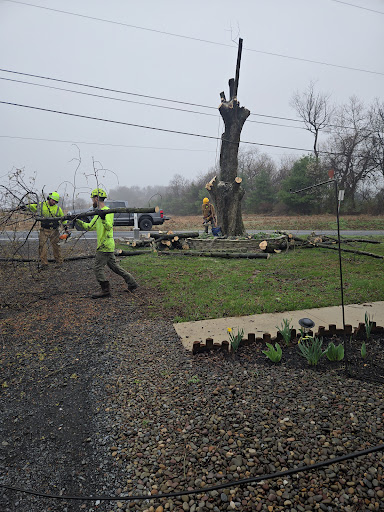
A forestry mulcher grinding brush and understory in a single pass in Wyomissing.
Built for Land Development, Utility, and Public Agency Projects Across Berks County
Utility companies use forestry mulching to keep transmission and distribution corridors clear of encroaching vegetation without the soil disturbance that comes with grading equipment, which matters when a corridor runs across sensitive terrain or near waterways. We follow research backed frameworks for integrated vegetation management on rights of way, which favor selective, lower impact clearing methods over repeated full width clearing, both for cost and for long term site stability.
Developers and general contractors use mulching to prep raw land ahead of a site plan, clearing understory brush and smaller trees so surveyors, engineers, and grading crews can see and access the property before the larger clearing and grading phase begins. Municipalities and school districts use it to reclaim overgrown park land, open trail corridors, and restore sightlines along public land without the cost of a full excavation crew. In each case, the mulch left behind also reduces erosion risk on disturbed soil until permanent landscaping or paving is in place, which matters for any site working under a stormwater or erosion control plan.
What a Commercial Mulching Estimate Includes
Every estimate spells out the acreage to be cleared, the density and size of vegetation involved, and whether any areas need to be avoided or handled separately, such as protected trees, wetland buffers, or utility markers. We put this in writing before equipment arrives so a property manager, developer, or agency contact has a real number and a clear scope to work from, not a rough per acre estimate that changes once the crew sees the site.
Access and terrain factor directly into how a mulching job is scoped. A slope, a wet section of ground, or a corridor with limited equipment access all change how quickly a crew can work and which machine is the right fit for the site. We walk the property or review site plans before quoting, so the estimate reflects real ground conditions rather than a flat rate that assumes every acre clears the same way. For larger multi phase projects, such as a utility corridor spanning several miles or a development parcel being cleared in stages, we can also schedule the work in sections that match a client's own project timeline instead of requiring the entire area to be done at once.